Intervals
The distance between two notes is called an interval. There are two basic
types of intervals in music: melodic and harmonic. A melodic interval occurs
between consecutive notes of a melody. A harmonic interval occurs between
two notes that are played at the same time.
There are two elements to the labelling of intervals in music. The first
element is the interval number and the second element is the interval prefix.
The most general measurement of an interval is the interval number. The
interval number does not precisely measure an interval and the interval
prefix is needed along with the interval number in order to provide an exact
measurement of an interval.
Interval Number
The interval number is a measurement of the difference in the two notes
in regard to their position on the staff. To determine the appropriate number
for an interval, count (starting with the number 1) the line/space positions
from the lower note to the higher note.
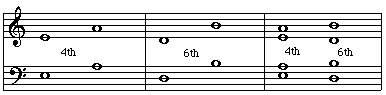
As an example, the interval from the note E up to the note A is a 4th
(counting the E line position as one; 1- "E" line, 2- "F"
space, 3- "G" line, 4- "A" space).
Likewise, the interval between D (space below the staff) and B (middle
line) is a 6th (counting the "D" space as one; 1- "D"
space, 2- "E" line, 3- "F" space, 4- "G" line,
5- "A" space, 6- "B" line).
The examples in this chapter use both the treble and bass clefs and the
labelled interval is in both the treble and bass. The listed interval does
not pertain to the distance between notes in the treble and bass.
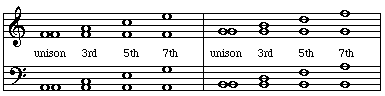
Notice that both of the notes of odd numbered intervals (3rds, 5ths,
7ths, etc.) are on either lines or spaces.
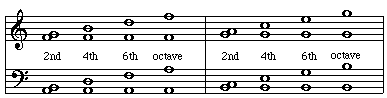
Conversely, on the even numbered intervals (2nds, 4ths, 6ths, etc.) one
note is on a line and the other is on a space. This visual guide can help
you quickly identify intervals.
Counting Half Steps
In order to precisely measure and label intervals you must count the
half step distance between the two notes. When counting the interval number
you started your count with the number one, however when counting half step
distances you should start your count by designating the first note of the
interval with the number zero then count each additional half step from
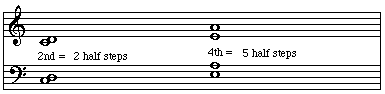
that note to the other note of the interval. As an example the distance
in half steps between the notes C and D is two half steps (count C =0, C#=
1, D= 2), and the distance from E to A is five half steps (E=0, F=1, F#=2,
G=3, G#=4, A=5)
Five different terms are used as the interval prefix: Perfect, Major,
Minor, Diminished, and Augmented. These terms are used to describe what
is known as the quality of an interval.
The major scale is used as a model to define the Perfect and Major intervals.
Starting from the first note of a major scale and measuring to the other
tones of the scale, the following intervals are defined.
Perfect Unison (two notes that are the same)
Major Second (First note to the second note of the scale)
Major Third (First note to the third note of the scale)
Perfect Fourth (First note to the fourth note of the scale)
Perfect Fifth (First note to the fifth note of the scale)
Major Sixth (First note to the sixth note of the scale)
Major Seventh (First note to the seventh note of the scale)
Perfect Octave (First note to the first note of the next octave)
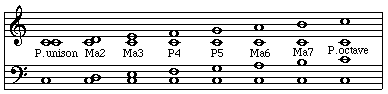
When starting from the first note of a Major scale, there are no ascending
intervals of minor, diminished or augmented quality.
Intervals of an unison, fourth, fifth, and octave are sometimes referred
to as Perfect. In order to be a perfect interval there must be a precise
distance, measured in half steps, between the two notes. As stated above, the
intervals from the first note of major scale to the fourth, fifth, and octave
are referred to as "Perfect" in regard to their interval prefix.
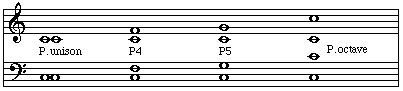
These perfect intervals have a specific measurement in half steps as shown
below.
Perfect Unisons have 0 half steps (i.e. C to C)
Perfect Fourths have 5 half steps (i.e. C to F)
Perfect Fifths have 7 half steps (i.e. C to G)
Perfect Octaves have 12 half steps. (i.e. C to the next C)
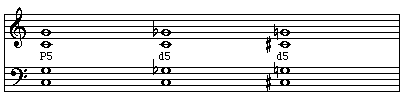
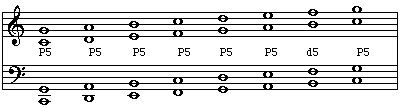
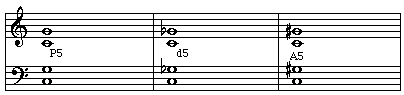
Any perfect interval made smaller by one half step becomes diminished.
As an example the notes C to G comprise a Perfect Fifth (7 half steps),
yet the notes C to Gb comprise a Diminished Fifth (6 half steps) because
the distance is one half step smaller than the Perfect Fifth C to G. Similarly,
the interval from C# to G is also a Diminished Fifth (6 half steps).
While Fourths, Fifths, and Octaves can be diminished intervals, the most
common diminished interval is the Diminished Fifth. In more rare musical
situations you might encounter a Diminished Fourth or Diminished Octave.
When measuring the fifths that are inherent in the major scale, you will
notice that all are perfect except one. The fifth interval above the 7th
scale degree is a diminished fifth while the fifth interval above all other
scale degrees is a perfect fifth.
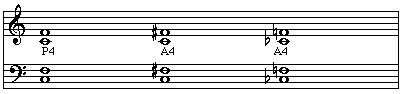
Any perfect interval made larger by one half step becomes augmented.
As an example, the notes C to F comprise a Perfect Fourth (5 half steps),
yet the notes C to F# comprise an Augmented Fourth (6 half steps) because
the distance is one half step larger than the Perfect Fourth C to F. Similarly,
the interval from Cb to F is also an Augmented Fourth (6 half steps).
While Unisons, Fourths, Fifths, and Octaves can be Augmented intervals,
the most common Augmented intervals are the Augmented Fourth and the Augmented
Fifth interval (in addition to Augmented 2nds and Augmented 6th intervals
mentioned below). In more rare musical situations you might encounter an
Augmented Unison or Augmented Octave.
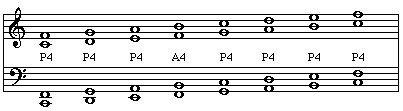
When measuring the fourths that are inherent in the major scale, you
will notice that all are perfect except one. The fourth interval above the
4th scale degree is an augmented fourth while the fourth interval above all
other scale degrees is a perfect fourth.
The terms Perfect, Diminished or Augmented are valid prefixes for the
intervals of unisons, fourths, fifths, and octaves. The terms Major and Minor
are never used as prefixes for unisons, fourths, fifths and octaves
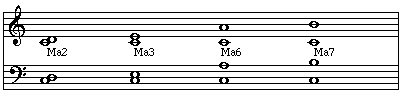
The intervals of seconds, thirds, sixths and sevenths sometimes have a prefix
of Major. In order to be a major interval there must be a specific distance
in half steps between the two notes of the interval. As stated above, the
intervals from the first note of major scale to the second, third, sixth
and seventh are referred to as "Major" in regard to their interval
prefix. These major intervals have a specific measurement in half steps
as shown below.
Major Seconds have 2 half steps (i.e. C to D)
Major Thirds have 4 half steps (i.e. C to E)
Major Sixths have 9 half steps (i.e. C to A)
Major Sevenths have 11 half steps (i.e. C to B)
Each tone of a major and minor scale is an interval of a 2nd from its
adjacent scale tone. All of the whole step intervals within a scale formula
are "Major seconds". As an example, the major scale formula is
W-W-H-W-W-W-H (W=whole step, H=half step), indicating that five major seconds are used.
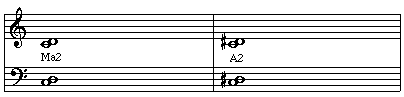
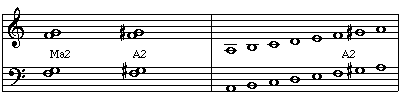
Major intervals made larger by one half step become Augmented. For example,
since the interval for F to G (2 half steps) is a major second , the interval
from F to G# (3 half steps) is an augmented second. An augmented second
interval exists between the sixth and seventh scale degrees of all harmonic
minor scales.
Although any interval can have a prefix of Augmented, the more common
augmented intervals in music are the Augmented 2nd (as stated above) and
Augmented 6th (in addition to the Augmented 4th and Augmented 5th mentioned
in the previous section on augmented intervals). On more rare occasions
one may find other augmented intervals.
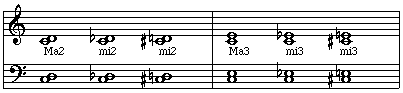
Major intervals made smaller by one half step become Minor. As an example,
given that the interval from C to D is a major 2nd, the interval from C
to Db is a minor 2nd (the interval from C# to D is also a minor 2nd). Likewise,
since the interval from C to E is a major 3rd, the interval from C to Eb
is a minor 3rd (the interval from C# to E is also a minor 3rd).
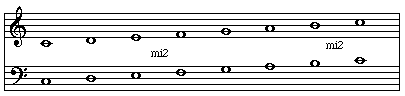
The half step intervals in the major scale formula are the location of
minor seconds within the scale structure.
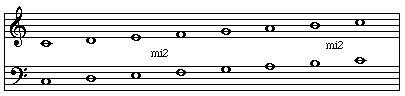
Notice that the Harmonic minor scale has three minor 2nds within the
scale structure.
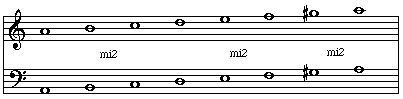
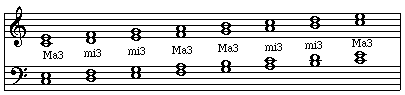
Both Major and Minor scales have several minor intervals within their
structure. When considering the intervals of a 3rd inherent in the major
scale, there are four different minor thirds: 1) from the second note to
the fourth note of the scale. 2) from the third note to the fifth note of
the scale. 3) from the sixth note up to the first note (first note, next
octave) and 4) from the seventh note up to the second note of the scale
(second note, next octave).
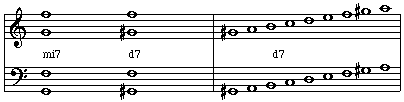
Minor intervals made smaller by one half step become Diminished. As an
example, since the interval from G up to F is a minor 7th, the interval
from G# up to F is a diminished 7th. All Harmonic minor scales
contain a diminished 7th interval from the seventh note up to the sixth
note of the scale (sixth note, next octave).
A harmonic minor
7 1 2 3 4 5 6 7 8
The terms Major, Minor, Diminished or Augmented are valid prefixes for
the intervals of seconds, thirds, sixths and sevenths. The term Perfect is
never used as a prefix for seconds, thirds, sixths and sevenths.
The interval prefix qualities can be summarized as follows:
1) Major intervals made smaller by one half step become Minor.
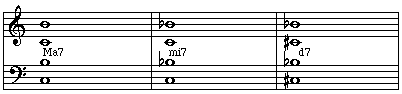
2) Minor and Perfect intervals made smaller by one half step become Diminished.
3) Major and Perfect intervals made larger by one half step become Augmented.